The anamnesis is composed by civic information, physical activity or hobbies, occupation, history of the disease as well as the patients bio-psychosocial environment.
The various bio-psychosocial factors are important to take into account when managing a patient with chronic pain.
Cervical Assessment
The different parts of the cervical spine assessment.
- Anamnesis
- Type of pain
- Objectives
- Red flags
- Neurological assessment
- Joint assessment
- Muscle assessment
- Temporomandibular joint
- Visceral assessement
- Synthesis
- Patient follow-up
- Appendices
- Sources
1. Anamnesis

2. The type of pain
Pain is first assessed by determining the part of the sensory and the emotional in the pain intensity. Then thanks to a body chart adapted to lumbar pathologies, where the patient can himself represent his pain.
Finally, for a good treatment, it is useful to clearly define the type of pain. Pain can be classified into three categories, nociceptive, neuropathic or by central sensitization (see source 1), in particular thanks to the questionnaires of Neuropathic Pain (DN4, here) and of the Central Sensitization Inventory (CSI, here).
3. Treatment goals and objectives
The objectives are defined with the patient in order to know this expectations of the treatments. They allow us to know how are the expectations of the patient ‘s pain evolution. They help the patients compliance and adherence to the therapeutic plan to achieve the goals developed together.

4. Red Flags
Red flags (see source 2) specific to cervical spine must be identified and the patient refered if necessary.
A summary table helps to check that the patient does not have any infection, fracture, myelopathy, tumor, dizziness, ligament instability, vascular disease, or inflammation.
Sharp Purser Test


5. Neurological assessment
If nervous tissue damage is suspected, an assessment of sensitive and motor deficits is done to start the neurological examination.
Osteo-tendon reflexes are tested to determine if there is central or peripheral nervous system
damage.
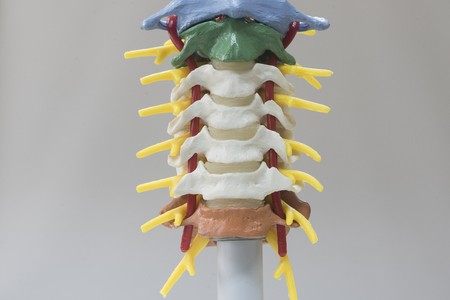
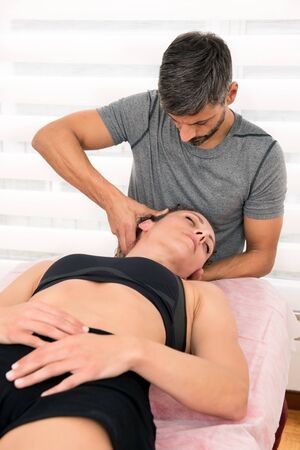
In peripheral involvement, the Wainner cluster (see source 3), neurodynamic tests of the upper limb or the demonstration of a thraco-brachial outlet syndrome, specify the type of neuralgia. If necessary, cervicogenic headache assessment tests (see source 4) or cervical-arthritis myelopathy are performed.
Wainner Cluster

Upper limb neurodynamic testing


7. Muscle assessment
Endurance tests of the deep and superficial flexors of the neck as well as the neck extensors are used to assess muscle condition. Motor control of the cervical spine is also assessed by active movements.

8. Temporomandibular joint
It can be the cause of neck pain due to blockages, problems with occlusion or mouth opening, muscle hypertonia, bruxism, swallowing disorders …
9. Visceral assessement
The visceral assessment can be performed in case of suspicion of referred or projected pain of visceral origin (oral cavity, throat, thyroid, thoracic and abdominal viscera).

10. The Synthesis
The summary makes it possible to highlight the essential points of the assessment and to avoid confusion in the face of all the information provided by the patient.

11. Patient follow-up
A part is dedicated to patient follow-up in order to note the changes session after session as well as the advice and exercises to be performed.

12. Appendices
The complete appendices and details each section of the assessment with a description of the clinical signs, the reference values of the tests, with summary tables and diagrams.
In case of doubt, a quick glance at the appendices will provide the answer to your question.

Sources
- Nijs J, Apeldoorn A, Hallegraeff H et al. Low Back Pain: Guidelines for the Clinical Classification of Predominant Neuropathic, Nociceptive, or Central Sensitization Pain. Pain Physician. 2015 May-Jun;18(3):333-46.
- Peter R. Blanpied, Anita R. Gross, James M. Elliott et all. Neck Pain: Revision 2017 Clinical Practice Guidelines Linked to the International Classification of Functioning, Disability and Health From the Orthopaedic Section of the American Physical Therapy Association. J Orthop Sports Phys Ther. 2017 Jul;47(7):A1-A83.
- Wainner RS, Fritz JM, Irrgang JJ, Boninger ML, Delitto A, Allison S. Reliability and diagnostic accuracy of the clinical examination and patient self-report measures for cervical radiculopathy. Spine (Phila Pa 1976). 2003 Jan 1;28(1):52-62.
- Toby Hall, Kathy Briffa, Diana Hopper, Kim Robinson. Long-Term Stability and Minimal Detectable Change of the Cervical Flexion-Rotation Test. J Orthop Sports Phys Ther. 2010 April ; 40(4) :225-229
